of the population suffers from back pain every year.
100+ billion USD
in annual costs in the US alone.
69%
of patients relapse after treatment with conventional methods.
A huge impact on health, productivity, and social life.
The current roadblock
Traditional methods have limited effectiveness and high relapse rates.
Existing digital technologies are expensive, hard to use, and only practical in large clinics.
They cannot treat patients in the subacute stage, when physical therapy is highly effective.
They cannot treat patients for prevention, because there are no measurable prevention standards.
The result: the “epidemic” of chronic patients keeps spreading.
Assessment, compensation, and treatment in a single computerized system
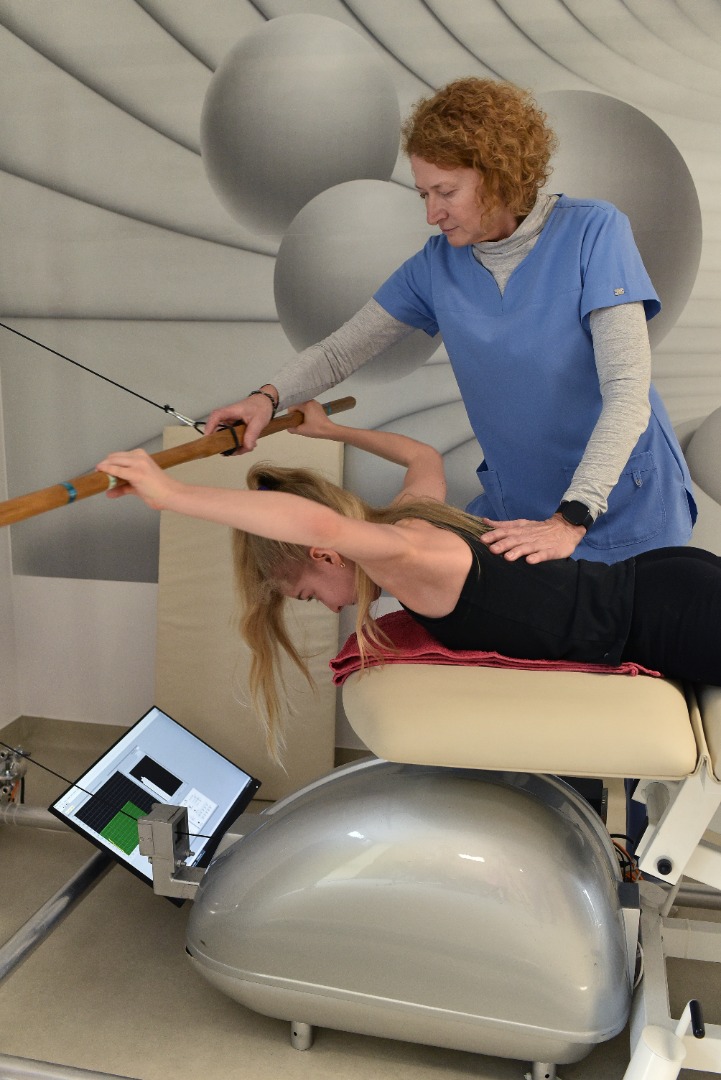
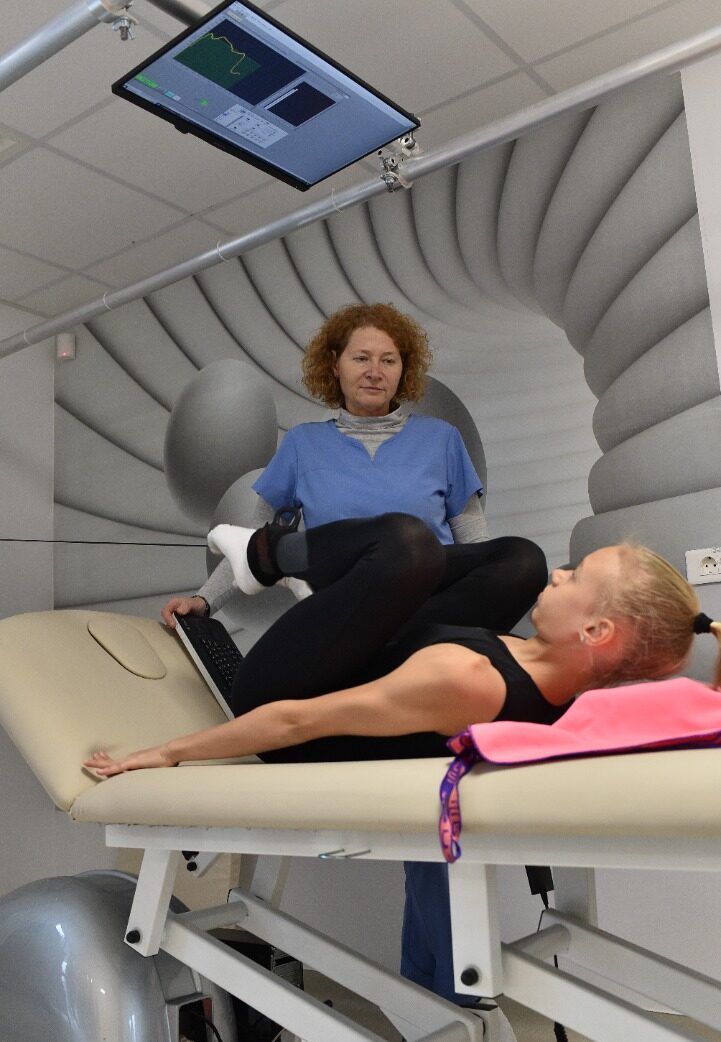
A computerized system for assessment, detection of musculoskeletal imbalances of the trunk, compensation, and treatment.
Identifies muscle imbalances and compensates for them before the structures of the spine are affected.
Eliminates pain and reduces the risk of relapse to almost zero.
Cuts recovery time and the number of sessions in half.
Suitable for small practices as well as large clinics, fitness centers, and elite sports.
The technology
20 years of research and clinical validation.
Inspired by the Williams & McKenzie methods, but computerized and improved.
Proprietary algorithms (CECTAP, CETOLO) for assessing muscle balance.
Real-time visual feedback for greater efficiency.
Complex multi-joint movements for assessment and treatment.
Competitive advantages
An investment 5 times lower than competing solutions.
Only 3 tests required.
The only solution with no direct competition in the segment of individual practices and small clinics.
Also fully suited to large clinics, with an advantage in price, quality, and ease of handling.
Clinically validated, with fast and lasting results.
The market
The physical therapy market is growing
billion USD
Physical therapy equipmentCAGR 6.9%
20.9202338.22032
Source: GlobeNewswire
Physical therapy servicesCAGR 5.5%
58.27202584.832032
Source: Coherent Market Insights
<0.2%
adoption rate of digital solutions: a huge opportunity.
Each dot is 0.2% of the market. Digital solutions fill less than one dot today.
Target segments
Individual practices
A natural monopoly, with no direct competition.
Large clinics
Where BackFix has an advantage in cost, quality, and ease of handling.
Extensions
Fitness centers, elite athletes, corporate health programs.
A unique opportunity created by a paradigm shift in the treatment and prevention of back pain
Existing digital methods have reached their limits: they are costly and hard to apply, they do not allow early intervention, and they cannot stop the spread of the “epidemic” of chronic patients. The result: huge costs for patients, society, and healthcare systems.
The core of the BackFix paradigm shift
Detecting muscle imbalances of the trunk through the adjacent movement chains (arms, legs), which reflect imbalances in the muscles that stabilize the spine.
This idea was implicit in the Williams & McKenzie methods, but it could not be put to use at the time because of the technology then available.
BackFix puts this vision to work through computerization, proprietary algorithms, real-time visual feedback, and standards for the functional musculoskeletal optimization of the spine and trunk.
As a result, treatment becomes possible as early as the subacute stage, or for prevention, compensating for imbalances before the structures of the spine are affected.
Results of the paradigm shift
Only 3 tests required.
Symmetrical movements with self-elongation.
Simple construction and easy application.
Lower costs, greater accessibility.
Use in small practices and large clinics.
Impact on the business model
A much wider market: independent practices (no competition) and large clinics (where the advantages are decisive).
New segments: fitness centers, athletes, corporate wellness.
Customer loyalty and recurring subscriptions for prevention.
Social impact
Stopping the spread of the epidemic of chronic patients.
Lower costs for healthcare systems.
Higher productivity of the working-age population.
Direct interest for health insurance funds focused on prevention and on reducing costly treatments.
Greater efficiency and effectiveness of the therapeutic process in clinics and individual practices.
BackFix stops the “epidemic” of chronic patients through early detection and compensation of muscle imbalances. This paradigm shift lowers costs for healthcare systems and sets a new standard in the prevention of spinal conditions.
Business model and projections
Affordable equipment sold to practices, clinics, and fitness centers, complemented by training and prevention subscriptions.
Direct sales
To clinics, individual practices, and fitness centers.
Medical distributors
Partner distributors of medical equipment.
BackFix Academy
Training and support for the specialists who use the system.
Prevention subscriptions
Customer loyalty and recurring revenue from prevention programs.
Estimated market share in 5 years
Percentage of the clinics and fitness centers in each market.
Clinics · Europe9%
Clinics · US2%
Fitness · Europe3%
Fitness · US2%
Estimated gross margin
40%
With a customer investment 5 times lower than competing solutions.
Dr. Daniela Schor, PhD25 years of experience in physical therapy and rehabilitation.Dr. Vladimir Schor, PhD40 years of experience in motion control systems.Dr. Liviu Kreindler, PhD25 years of experience in automation, Tehnosoft.
Traction and validation
5 systems in operation since 2015.
Already used in 3 clinics in Bucharest, with results over more than 15 years.
Clinical studies and collaborations with UNEFS and Olympic athletes.
Validated on non-athlete patients and elite athletes.